how to draw a taiga pin tree
How to draw a tropical forest. How to draw a taiga forest: mixed and broad-leaved
When a person first picks up a pencil to draw a forest, he is faced with a problem: how to draw a huge number of small details? As a child, I asked a similar question to my teacher: "How should I draw trees correctly - draw all the leaves or not?" To which he replied with a smile: "Of course not!" How, then, to draw a forest correctly?
1. Transfer of space and perspective in the drawing of the forest.

When artists paint interiors or city streets, then everything is clear with perspective. Rectangular, simple geometric shapes easily fit into a perspective reduction. Here it is easy to outline the horizon line and bring all sides of the buildings to the vanishing point. But how is the space organized in the forest, where it is filled with all sorts of branches, snags, foliage ... In the illustration, I specially drew a diagram of five planes, reminiscent of a room. It's easier to imagine space for a novice artist. Further, against this background distribute trees. Trees have trunks and a crown, where the forms are far from simple geometric ones. They are "clumsy" because they have many bends and kinks, and are also replete with details such as bark, small branches, etc. But, despite these "difficulties", they also subordinate linear perspective just like rectangles. The trunks of trees in the foreground are larger, in the second they are smaller, etc. In addition, one tree covers another or one branch covers part of another branch. The trees in the foreground are so large that they do not fit in the sheet and go beyond it. Thus, the viewer finds himself inside the forest, and is not an observer from the side when the forest is built as a wall near him.
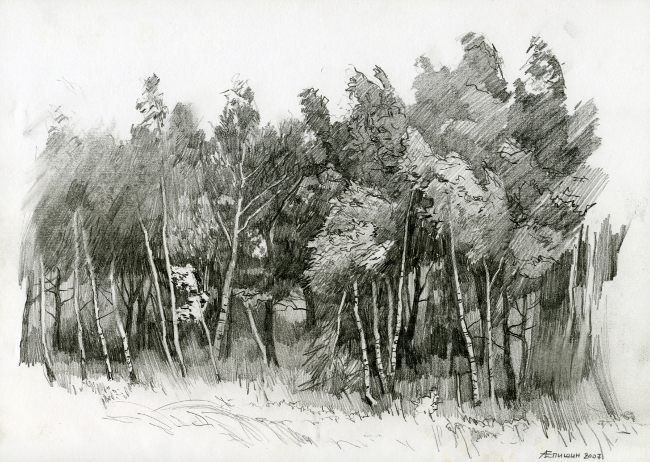
In the illustrations, I gave an example from my drawings, where the forest is drawn "from the side" and "from the inside." Therefore, one must remember that it is possible different angles and points of view. I.I. Shishkin liked to paint the forest, "placing" the viewer inside.
2. Generalization of small details into masses of large, medium and small sizes.

In the drawing of the forest, of course, you can select individual leaves, focusing on the compositional center. I devoted a separate article to this issue, which you can read. However, more often the artist has to generalize. It is generalization that is always more difficult for beginners than drawing details. But it is necessary. So what should be generalized and how? You need to generalize individual leaves and branches that form groups or masses. These groups should not be made the same size. Everything in nature is dynamic. Therefore, the drawing must be dynamic, and this is achieved through the transfer of rhythm. Rhythm is created when the artist does not make "sameness" in the drawing. Therefore, the masses of foliage will different in size- large, medium, small. But the rhythm will be transmitted not only in size, but also degree of generalization. We generalize some masses of branches and leaves, literally blurring the image. For example, it is appropriate in the background. And we generalize some groups not so much: in them one can distinguish a kind of foliage that forms a "clumsy" texture. Well individual groups in the foreground, of course, they will contain details: carefully traced leaves and branches. However, they will belong this group. But, separately located trees, branches, leaves need to be detailed with care. If there are too many such objects in the drawing, they will look "glued" to the drawing, and will not part a single whole, which will cause the effect of "cartoonism" and unnaturalness.
3. Volume in natural forms.

It is, of course, easier to convey the volume of a cylinder or a ball when we draw a still life. But in the forest, there are no such forms. At first sight. But if you look closely, then basis the shape of tree trunks lies all the same cylinder. AT basis intricate forms of foliage groups - ball. AT basis paths in the forest - tetrahedral corridor shape. Etc. realizing natural forms it is easier for an artist to generalize and convey volume. Chiaroscuro can be seen on tree trunks, on masses of foliage and individual leaves, on the entire crown of a tree, and even on whole group many trees. As an example, I have illustrated chiaroscuro on a tree trunk. Although its shape is based on a cylinder, it still has irregularities, bends. In addition, the trunk is covered with bark, which has its own characteristics for each tree species. Therefore, hatching will not be smooth, but more textured. Here, each artist has his own hatching techniques, so let's not philosophize beyond what is necessary and create unnecessary patterns. As for chiaroscuro in general, it is built from light, penumbra, shadow, reflex and falling shadow. On a jug, in a still life drawing, it's easier to figure it out. And how to see such subtleties in the mass of foliage? Observation is important here. No wonder I.I. Shishkin is called a naturalist. He studied nature in detail, memorizing the varieties of herbs and trees. Therefore, watching the forest, you can see all the nuances of chiaroscuro in foliage, branches, etc. academic drawing this is called light-shadow modeling of the form. That is, modeling. That is, here you need to model, not copy, but understand the essence, observing nature.
In drawing a forest, of course, there are other issues that cannot be covered in one article. But the three aspects that I have listed here are the key ones. Therefore, I called them the keys to success. Keeping them in mind, you can learn how to draw a forest professionally and competently.
→ Draw a forest
What you need
In order to draw a forest, we may need:
- Paper. It is better to take a medium grain special paper: it will be much more pleasant for novice artists to draw on this one.
- Sharpened pencils. I advise you to take several degrees of hardness, each must be used for different purposes.
- Eraser.
- Stick for rubbing hatching. You can use plain paper rolled into a cone. She will rub the shading, turning it into a monotonous color.
- A little patience.
- Good mood.
Step by step lesson
Real nature in all its glory can be revealed only if you draw it from nature. It will be much better to draw if you look directly at the forest. If this is not possible, then they can help out regular photos, which are simply in bulk in search engines.
By the way, in addition to this lesson, I advise you to turn your attention to the lesson "". It will help improve your mastery or just give you a little pleasure.
Tip: sketch with as light strokes as possible. The thicker the strokes of the sketch, the more difficult it will be to erase them later.
The first step, or rather zero, is always to mark a sheet of paper. This will give you an idea of where exactly the drawing will be. If you place the drawing on half of the sheet, you can use the other half for another drawing. Here is an example of a sheet layout in the center:
Step one. Let's start with a simple one: draw a horizon line, and with two vertical lines let's draw a path.

Step two. On the sides of the invented path we draw tree trunks, large and small.

Step three. Let's draw the trunks higher, and sketch their bottoms with a pencil. We will also add some grass at the foot of the trunks.

Sha fourth. Finally, draw the tops with branches, add shadows.

Step five.

Step six.

Save the forest - use paper on both sides (just not in the toilet). But it is better to plant new plants.
So you learned how to draw a forest, I hope it was interesting and informative. Now you can pay attention to the lesson "" - it is just as interesting and exciting. Oh, and buttons. social networks it's not just like that =)
Trees are almost always the most striking and characteristic indicator of those geographical conditions that are specific to a particular area. Therefore, it is natural that the artist should approach the vegetation with special attention, and his sketches should be made with particular care. So, for example, if he draws a pine tree, then he should have a pine tree in his drawing, and not just a tree. Let's talk how to draw trees with a pencil.
Trees do not always have such characteristic appearance, which has a pine. Nevertheless, many trees have a fairly typical appearance. The most characteristic trees of our forests are from coniferous spruce, pine and larch, and from deciduous birch, oak, partly Linden. From the southern pyramidal poplar, cypress, palm trees and some others. It is with these, the most typical trees, that we, first of all, will get acquainted.
Children very often draw trees. And the question of how to draw trees with a pencil appeared for many at school or kindergarten.
How to draw a Christmas tree (spruce)
Spruce is so characteristic that it is easy to remember and depict even children preschool age(Fig. 1).

Figure 1 - Spruce in the image of children
Before you know how to draw a christmas tree, you need to find out what is characteristic in this tree? A tall upright trunk, a whorled arrangement of branches, with whorls of branches going almost from the base to the very top, the branches are densely pubescent with needles. All this is arranged in a certain natural order. The branches of the upper whorls are short, thin, and stick out to the sides and even slightly upwards. The lower whorls consist of heavy branching, rather long rays, which, due to their gravity, hang down. A little later we will look at how to draw deciduous trees with a pencil.
Spruce Drawing Examples

Figure 2 - Developed and undeveloped "whorls" of a young spruce
Speaking of character drawing a young spruce, we must recall one more detail. Every year a new whorl grows from above. But not every whorl is preserved. Usually the stronger ones survive and jam the nearest, lower whorls. As a result, fairly large distances are obtained between the preserved whorls. From the dead whorls, only traces remain in the form of dried and broken branches. To draw a spruce, it is necessary to depict precisely these features.

Figure 3 - Simplified drawing of an adult spruce
Look at figure 2, how a young Christmas tree is drawn. The rays of her whorls are still light, and they almost do not hang down. Drawing an adult Christmas tree a little different. Heavy lower branches (legs) hang almost to the ground (Figure 3). If we do not know the nature of the structure of the trunk, the nature of the branching of the whorls, then we will not be able to correctly depict the spruce. Any person who hardly knows how to draw will draw a spruce if he only understands the nature of the structure with the trunks of whorls. Thus, before drawing a spruce, you need to familiarize yourself with the "anatomy" of a spruce. This is easily achieved if we think over and draw first a simplified diagram of the "skeleton" of a tree (Fig. 4), then a young spruce (Fig. 5) and, finally, an adult spruce (Fig. 3).

Figure 4 - The skeleton of a young spruce

Figure 5 - More mature spruce
When the spruce is worked out, you can move on to drawing firs and a spruce forest from a distance. (We need these exercises so that later, when depicting landscapes, we do not need to think about how to draw a spruce, how to draw spruce forest and far, and near, and on the plain, and on the slope of the mountains.)
Draw a spruce forest
Spruce forests, even from afar, do not lose their external features. They are distinguished by their pointed top. We are no longer talking about the characteristic blue velvet tone, which spruce forest differs sharply from other forests located at the same distant distance. Of course, we do not set the transfer of tone in front of us yet, but we will have to depict the transfer of the nature of the mass of a spruce forest (Fig. 6).

Figure 6 - Drawing Christmas trees at different distances
When drawing a Christmas tree, you have to apply hatching. The distant trees, in which it is impossible to make out the details, can be covered with a simple stroke, the most distant ones - with vertical strokes. Each such stroke should, as it were, emphasize the character of tall and relatively narrow trees. On nearby spruces, not only large whorl branches are clearly visible, but also small, usually hanging down, branches densely pubescent with needles. We cannot draw such details, but by means of vertical hatching we can also convey the character of these hanging branches (Fig. 3). It is clear that there are strokes in various parts spruces are not the same. On the lower branches, they can be thicker and longer, and thinner and shorter on the upper ones. These drawings are initially more convenient to do with a pencil.
How to draw a pine
Pine, like spruce, belongs to conifers, but there is a huge difference between pine and spruce. Spruce is shade-loving. It can grow in dense forest in conditions of almost twilight lighting. Pine, on the contrary, is extremely photophilous. Pine puts up with stone soil, with sands, with a lack of moisture, but dies with a lack of light. Thus, pine and spruce have a completely different attitude to light, and hence a different appearance, therefore, there is a difference in how to draw a pine.
young pines, growing in an open place, are generally similar to spruce, only the rays of the whorls are less frequent and the needles are longer. The rare arrangement of branches is already a consequence of light-loving. As it grows, the lower branches, darkened by the upper ones, die off. And the upper branches, in the struggle for light, develop very unevenly. Strongly developed individual rays of whorls turn into thick branches that grow into wide umbrellas. The weak rays of the whorls perish. We see the remains of these dead branches on any pine tree. As a result of the struggle for light, the character of the crown changes so much that the mature pine no longer resembles spruce, and even the whorled arrangement of branches becomes hardly noticeable (Fig. 7).

Figure 7 - How to draw a pine tree: on the left - a pine tree growing in an open area, on the right - simplified silhouettes of pine trees
Having understood the characteristic ones, we better understand how to draw a pine tree. First, we will deliberately make the most simplified drawings, in which all the most character traits(Fig. 7). It is very useful to see separately growing pines in nature, and then pines in the forest. It is also useful to view paintings by artists. In the paintings of a painted pine tree, everything that is most characteristic is usually expressed.
We draw a pine tree in the forest
So far we have been talking about pine growing in the open. Conditions in the forest are different. There the pine fights with the neighboring pines. The struggle for light leads to the rapid upward growth of some pines and the death of others, which lag behind in their growth. As a result, the pine trees in the forest have a tall cylindrical trunk, almost devoid of branches, and dense at the top. In a pine forest you can always see trees that differ in their vitality. Some have tall and, compared to others, thick trunks, with a richly developed crown, rising above neighboring crowns. These are the "dominant" trees. Nearby there may be weaker pines with a thin, but also high trunk and a less developed crown. Finally, there will also be pine trees with very thin trunks and a poorly developed crown, which cannot break out into the open space. These are "oppressed" trees, dying or completely dead, devoid of green needles (Fig. 8).

Figure 8 - Pine in the forest: a- "dominant" b and in- the oppressed G- dead.
Pine forest drawing
Just as we drew a spruce (first close, then far, then moving on to groups of spruces and a spruce forest), we will draw pine trees. As you move away from the viewer, the outline of the pine tree becomes simpler, and, finally, the pine tree takes on the form that is close to the conventional pine icon used on profiles and some maps (Fig. 9).
A group of pines or a pine forest from a distance seems to be a dark mass, which from above has irregular, sparsely located, rounded teeth of various sizes. Below, if there is no edge, vertically standing trunks are clearly visible. These trunks are most conveniently conveyed by vertical strokes (Fig. 10). In general, it must be said that drawing pine forest and individual pines character strokes has great importance. However, due to the peculiarity of the pine crown, you can successfully use ordinary strokes.

Figure 9 - Near and far pines
Pines in different areas are not the same. So, the pine of the taiga zone is very different from the Crimean pine. The forms of the pines of the Mediterranean countries and Japan differ even more strongly. In the latter, the crown is more developed in width, which gives the pine the appearance of an umbrella with a flatter top. They also differ depending on the conditions in which they are located. Thus, free-standing pines in open areas have a thicker trunk, powerful branches and a richly developed crown (Fig. 7). The pines of mountain gorges, on the contrary, have unusually tall and relatively thin trunks with a small crown at the top (Fig. 11).

Figure 10 - Drawing a pine forest in the distance

Figure 11 - Trees in deep gorges where there are weak winds and low rainfall. Tree trunks are unusually elongated in height (Altai).
How to draw a larch
Larch is especially characteristic of the taiga zone of Siberia. But it is often found within our European territory. Larch differs from other conifers in that it loses its needles for the winter. The last circumstance in a certain way reflected in her appearance. In winter, larch does not have needles - this is already one of its features. Larch branches, devoid of needles, do not hold snow on them. Hence, the branches, devoid of needles and snow, even with their small thickness, very rarely bend downwards, as we saw in spruce, and more often freely stick out to the sides and even bend upwards in the upper parts of the tree (Fig. 12).

Figure 12 - Simplified "larch skeleton".
Larch has a tall upright trunk and a kind of whorled branching, which differs sharply from spruce and fir.
Let us give, as an example, several sketches of larches made in winter (Fig. 13 and 14). Larches that are far away retain their character well (Fig. 15).

Figure 13 - Simplified image of an adult and old larch in winter.

Figure 14 - Simplified drawing of a larch forest in winter
Larches are characterized by a light, bright green color in summer, very pleasing to the eye, pale yellow or silvery yellow in late autumn and a kind of green haze in spring.

Figure 15 - A highly simplified image of distant larches
How to draw a birch
White bark, peculiar branching and especially hanging thin branches - very characteristics our birch. Considering the branching of a birch, we immediately note those extending from the trunk, under sharp corners, rather thick branches, which in a similar way branch further, passing into thin and unusually long terminal branches.
The similar structure of the branches just determines their drooping. And the drooping of the branches largely determines the peculiar appearance of the birch, which we all know so well. Note that when drawing a birch just as in other cases, the most important is building the base of the tree: trunk, branching, the nature of the final thin branches and, finally, the foliage (Fig. 15 and 16).

Figure 15 - Simplified drawing of a birch without leaves and with leaves

Figure 16 - A series of gradually receding birch trees.
Draw trees: aspen and poplar
Aspen, growing on the site of forest fires and clearings, is distinguished by a thin, tall, upright trunk and thin branches extending sequentially from the trunk, most often at an angle of 30-40 ° (Fig. 17). Thin aspen branches do not hang down, the outline of the crown is simple, in the form of a lancet blade. There are also other forms of aspens with a powerful trunk and thick branches. This form is quite close to our usual poplar (Fig. 17).

Figure 17 - Left: We draw a young aspen without leaves and with leaves. On right: Scheme of branching and outlines of the crown of an ordinary poplar
As we can see, the question of how to draw trees with a pencil, is not unambiguous. Let's look at how to draw a tree like Lombardy poplar. It is very typical for our southern regions, especially for the steppe areas. It grows in small groups near rivers and other bodies of water and is especially common near dwellings. The appearance of poplar is very typical. It is determined by the presence of a tall upright trunk and a peculiar branching, as shown in Figure 18.

Figure 18 - Pyramidal poplar without leaves and with leaves
How to draw a tree with a pencil: linden
The appearance of the linden is such that it can be confused from a distance with some other deciduous tree species. Nevertheless, linden also has its own characteristics, which are easy to notice when compared, for example, with. poplar or oak. Linden is characterized by dividing the trunk into thick large branches, which most often depart from the trunk at sharp angles. Branches reach great length, densely branched towards the end. This dense branching leads to an increase in the weight of the terminal parts, which in turn leads to some drooping of the apical branches. The drooping is much less than that of birch, but more than that of poplar and oak (Fig. 19).

Figure 19 - Draw a linden tree
From a distance, linden groves and forests are distinguished by soft rounded outlines of crowns, resembling the tops of cumulus clouds.
Let's also look at how to draw trees like oak in pencil.
How to draw an oak
The oak has a different character with its strong and slightly bent branches. In contrast to drawing a tree such as linden, poplar and some other broad-leaved tree species, oak branches depart from the trunk at angles close to right. Branches of the second and third order depart approximately in the same way (Fig. 20). The branches are thick, knotty and densely pubescent at the ends (pubescence consists of thin branches and dense foliage).
This peculiar character of branching is observed not only on large mature trees, but also on young ones (Fig. 20). The general outline of the crown partly resembles the outline of an oak leaf, but with a secondary, pronounced serration (Fig. 21). Generally appearance oak expresses the inflexibility and strength of a mighty tree. No wonder oak is a symbol of resilience and strength.

Figure 20 - How to draw an oak tree correctly: Left: Simplified depiction of an oak tree with and without leaves; On right: Young oaks without leaves
Oak trees in the forest have a more elongated shape, but the main features remain approximately the same.

Figure 21 - Oak tree outline
Not being able to dwell on the features of our other less common or less characteristic trees, we will very briefly touch on some of the most typical southern trees with which we often have to meet. This should include cypresses, palm trees, baobab and some others.
We draw a cypress
Cypress a very typical plant for the Mediterranean countries, it is also widely distributed as an ornamental plant along the southern coast of Crimea.
Strongly elongated upwards, narrow, slender, with a sharp top, cypress is easily conveyed in the picture. Its strong upward elongation is due to great height trunk and characteristic branching (Fig. 22).

Figure 22 - Cypress trees and a diagram of their trunks and branching patterns
How to draw a palm tree
How to draw a tree like a palm tree is also of interest.
Palm trees are different, but they are characterized by the absence of branching and the emergence of fronds from approximately the same point. The correct transmission of the forms and character of the palm depends primarily on the correct image of this frond exit from one point. The general appearance of the crown is rounded and often fits easily into a circle (Fig. 23). It should be remembered that the upper fronds are the youngest, they stick up, and the lower ones are the oldest, they hang down and die.

Figure 23 - Left: Drawing a coconut tree; On right: Drawing a date palm.
The trunk of a palm tree is most often slightly curved in its upper part. The date palm has a slightly different character.
How to draw a baobab tree with a pencil
Very interesting for drawing baobab tree. The baobab has a very characteristic trunk, branching and crown. The baobab is characterized by a very thick and, in comparison with its height, short trunk. The height of the trunk before branching is usually only 2.5-3 times its thickness. The trunk at a certain height immediately begins to divide into 5-7 (rarely more) thick branches. These main branches immediately begin to branch and lose their thickness very quickly. Unlike a cylindrical barrel, they are conical in shape. The baobab has a dense and very wide crown (Fig. 24).

Figure 24 - Baobab without leaves
Nature is eternal source for inspiration creative people. Poets and prose writers, composers and artists dedicate their works to her. One of the most frequent subjects of landscapes is the forest. This is not surprising. He is so different. Good and beautiful at any time of the year. What kind of flowers you will not see in the crowns of trees!
Pencil painting
Each artist has his favorite materials for drawing, fortunately, now there is great amount their types. However, among the favorites is still an ordinary simple pencil.
Before starting work, the master needs to think about how to draw a forest with a pencil, since it is quite difficult to convey all the beauty of the landscape with just one color.
The difficulty may also lie in the fact that it is difficult for novice talents to convey a shadow.
To make the image more voluminous, it is necessary to apply it with strokes. Lines are best done in different keys.
How to draw a forest with a pencil in stages?
Choosing this type of drawing, you first need to depict common features. First of all, straight lines appear on paper. curved lines. These are sketches of future trees and hills. After that, you need to draw a few thick trunks.
The next step is to place the bushes and grass.
When this is done, you should depict the trees that grow in the background.
If all the main objects are already placed on the canvas, then you need to think about the details. In how to draw a forest, it is very important that the picture is believable. In order for the image to look realistic, the master uses shading. The stroke can be either horizontal or vertical. It is necessary to leave unshaded some areas of the image - those where the color falls. Similar effect can be achieved with an eraser.

tree image
Trees are the main components of the picture. Thinking about how to draw a forest, you should learn how to draw trees. When drawing a sketch of each individual tree on paper, some rules must be considered:
- the farther the object is, the more it will be enveloped in a bluish fog, and the contours of the image will look fuzzy, as if blurry (one of the rules of aerial perspective);
- the closer the tree is to the master, the more saturated the color of its crown will be.
Creating a beautiful texture can help right choice drawing paper: watercolor paper may have rough edges. They will help create beautiful view leaves and tree bark. To do this, do not press the pencil too hard, shading the surface.
In order for the image to look realistic, it is important to be able to correctly work with the foreground and background of the picture. For example, so that trees that are closer do not mix with those that grow a little further, they need to be painted with brighter colors.

Watercolor drawing
For those who prefer to paint with a brush, watercolors are perfect as paints.
Starting work, you need to sketch the landscape. This is best done with a pencil. Sketch with thin lines, otherwise a shadow may appear on the picture.
After the outlines are made, it is necessary to take up the image of the sky. Having chosen its location, it is necessary to apply ultramarine and cobalt colors to it. In order for the line of clouds to be clearly visible, it is better to draw its edge with diluted burnt umber. A good option if carmine is added to it.
If the question arose of how to draw a forest especially expressively, then you should know that for this purpose more attention is paid to the foreground. Grass is drawn with jerky, sharp movements.
Leaves can be depicted in any color that the imagination suggests. The most advantageous is the variation that uses a large number of various shades.
When choosing how to draw a forest, it is important to choose a method that will bring as much pleasure from creative work as possible. Young artists should sometimes listen to advice on how to choose the right light, what time of day to draw, how to correctly compose color scheme. But the main thing is unity with nature and a creative impulse.

If the artist has a developed sense of harmony, how to draw a forest in stages goes by the wayside. Any manner of execution will only emphasize beauty.
Hello dear friends!
I am sure that almost all of you are interested in the topic of creating landscapes. Landscapes can be very different, showing beautiful and interesting views of different parts of our planet, in many of them you come into contact with the task of depicting trees. How to draw a living, beautiful and natural tree is the topic of our today's lesson.
Trees are not difficult to draw, only sometimes they come out somehow too drawn or flat.
Basic Mistakes
The main mistakes in drawing trees are:
Lack of volume
The lack of volume in the drawing (in color or black and white) is achieved by using paints of different tone and intensity. Even on a cloudy day, some part of the crown and trunk will be more shaded, and some less. In the thick of foliage, the colors are always darker. Think of a tree as a ball (crown) and a cylinder (trunk) to understand how shadows form on this complex shape.
cavazosuntoonesch72.blogspot.com
Source: https://vakta.ru/en/payments-benefits-and-compensation/kak-narisovat-tropicheskii-les-kak-narisovat-les-taigi-smeshannyi-i/
0 Response to "how to draw a taiga pin tree"
Post a Comment